
What is 9 d'Octubre?
The 9th of October (9 d'Octubre in Valencian) is the Dia de la Comunitat Valenciana, the official day of the Valencian Community. It is the region's national day in the way that many places have one: a moment for Valencians to mark their identity, their language and their history.
The date commemorates the entry of King James I of Aragon into the city of Valencia in 1238, the founding event of the historic Kingdom of Valencia. That is a lot of medieval history, but you do not need to memorise it. What matters for a newcomer is simpler: this is the day Valencia celebrates being Valencia, with a civic procession through the old town, official ceremonies, and a charming, slightly sweet gift tradition that fills the city's bakeries.
New here? 9 d'Octubre is one of those local days that nobody explains to you when you arrive. You just notice the offices are shut and the cake shops are mobbed. This guide is the explanation.
9 d'Octubre 2026: The Day
In 2026, 9 d'Octubre falls on Friday 9 October. It is a public holiday across the whole Valencian Community, including the city of Valencia. And because it lands on a Friday, it produces a natural long weekend.
Date
Friday 9 October 2026
A long weekend, as the holiday lands on a Friday.
Status
Regional public holiday
Schools, public offices and many businesses close across the Valencian Community.
Main event
The Processo Civica
The civic procession carrying the historic Senyera through Valencia's old town.
The tradition
The Mocadora
A handkerchief of marzipan figures - Valencia's version of a Valentine's gift.
The shape of the day is consistent year to year: official ceremonies and the civic procession centre on the Placa de l'Ajuntament and the streets of the old town during the day, with cultural events, concerts and a generally festive mood around the city. The Ajuntament de Valencia publishes the precise route and timings closer to the date, so confirm the official programme nearer the time if you want to follow the procession.
9 d'Octubre 2026: the published programme
The holiday falls on Friday 9 October 2026, and the Ajuntament approved this year's programme in mid-September. The festival runs from Friday 2 October to the big day. This edition is built around the 750th anniversary of the death of Jaume I, so the Reial Senyera and the sword attributed to the king are shown together for the first time in years. Times below are the published ones; routes can shift on the day, so check valencia.es or visitvalencia.com before you set out.
The build-up
- Friday 2 to Tuesday 13 October the medieval market fills the Turia gardens between the Pont de l'Exposicio and the Pont de les Flors, next to Alameda metro. Craft and food stalls plus street performances, free to walk through, and the easiest part of the festival to bring children to.
- Friday 2 October, 20:00 the Entraeta Festera of Moors and Christians sets off from the Placa de la Verge and loops through the old town.
- Saturday 3 October, 17:00 the children's Moors and Christians entry runs from the Placa del Tossal to the Placa dels Furs by the Torres de Serrans. At 20:00, the Embaixades de la Conquesta, the staged surrender scene, is performed in the same square. Both are free and far less crowded than the main day.
- Sunday 4 October, 11:30 the floral offering at the Cathedral, followed by the alardo de arcabuceria, the musket salute, parading from the Placa de la Reina down Carrer de Sant Vicent to the Placa de l'Ajuntament. It is loud: it is black-powder muskets fired in a narrow street.
Thursday 8 October, the eve
- 10:00 to 21:00 the La Nostra Senyera display in the City Hall's Salo de Cristall, where the Reial Senyera and Jaume I's sword are shown together for the 750th anniversary. Free, and the single most unusual thing on this year's programme.
- 19:00, 19:30 and 20:00 the Cant a la Senyera sung by the Coral Polifonica Valentina, three short performances in the same hall.
- 19:30 Valencian dance, music and song in the Placa de l'Ajuntament, with a dansa popular following at around 21:00.
- 23:30 the fireworks over the river at the Pont de Montolivet. The riverbed gardens on either side give you the view without the crush.
Friday 9 October, the day
- 12:00 the Processo Civica. The Reial Senyera comes down from the City Hall balcony, this year alongside Jaume I's sword, and the procession goes up Carrer de Sant Vicent to the Placa de la Reina and the Cathedral for the tedeum, then down Carrer de la Pau to the Placa d'Alfons el Magnanim for the floral tribute at the Jaume I statue, returning by Pintor Sorolla and Carrer de les Barques. This is the ceremony that gives the day its meaning, and it is the one to see if you only see one thing.
- Around 14:00 the mascleta in the Placa de l'Ajuntament, the daytime gunpowder display Valencia is famous for during Fallas. It starts when the procession ends, so it can run early. Arrive well before, and keep your mouth slightly open so the pressure does not hurt your ears.
- 15:45 the Baixada de Gloria, which runs the entry route in reverse, from the Placa de l'Ajuntament along Carrer de les Barques and Poeta Querol to the Glorieta.
- 17:00 the XXI Entrada de Moros i Cristians, starting from the Glorieta gardens and coming up Carrer de la Pau, Poeta Querol, Carrer de les Barques, the Placa de l'Ajuntament and Avinguda del Marques de Sotelo towards Xativa, by the Estacio del Nord. It is the most spectacular street event of the day and it takes hours to pass. This year's parade includes groups from Catarroja, Massanassa, Benetusser, Aldaia, Sedavi, Paiporta, Alaquas, Quart de Poblet, Manises, Riba-roja and Chella, the towns hit by the October 2024 dana.
The practical bit. With the holiday on a Friday, 2026 gives the whole Valencian Community a three-day weekend, so trains and coaches out of the city book up early and the old town is busier than a normal Friday. Anything involving an office, a bank or a town hall needs to happen by Thursday 8 October.
Why It Matters If You Live Here
It is easy to treat 9 d'Octubre as just a day off. But for anyone settling into Valencia, it is one of the most useful days of the year to actually pay attention to, because it tells you what the region thinks of itself.
- It is a window into Valencian identity. Spain is not one uniform place; its regions have distinct languages, histories and characters. 9 d'Octubre is when Valencia's own identity, separate from a generic idea of "Spain", is on full display. Understanding it helps you understand where you live.
- It is the Valencian language's day in the spotlight. The ceremonies, songs and signage lean heavily on Valencian. If you have wondered why some things around you are not in the Spanish you are learning, this day is part of the answer.
- It affects your week. A regional public holiday means closures, changed transport timetables and a long weekend. Knowing it is coming saves you a wasted trip to a shut town hall.
- The Mocadora is a lovely way in. Buying marzipan for someone, or simply joining the queue at a confectioner, is a low-effort, genuine way to take part in a local custom rather than just observing it.
The Civic Procession & the Senyera
The central public event of the day is the Processo Civica: the civic procession. The word civic is the key to understanding it: unlike many Spanish festival processions, this one is not religious. It is a formal, municipal occasion, led by the city's institutions and civic associations.
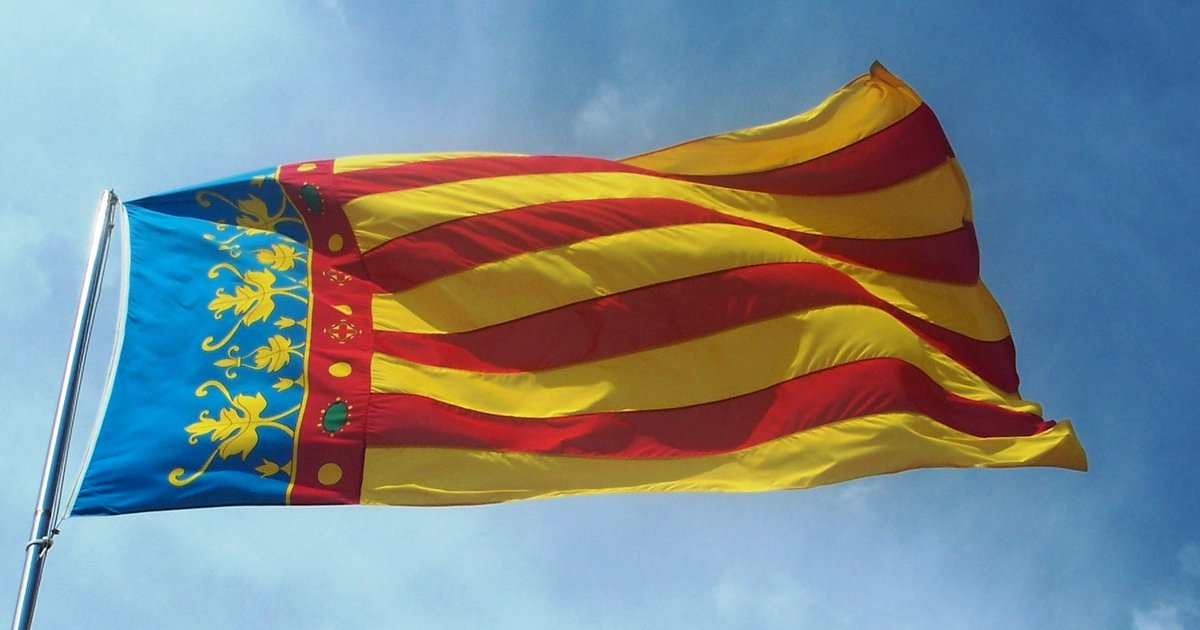
At the heart of it is the Senyera. The Senyera is the flag of Valencia: red and yellow stripes, with a blue band by the pole, topped on the city's version with a crown. The historic city Senyera is treated as a deeply revered civic symbol. By long tradition it is carried out from the balcony of the City Hall, taken down a fixed route through the old town, and (famously) it is never lowered or dipped. The flag is carried upright the whole way; the legend is that even when it crosses bridges, it does not bow. Whether or not the detail is literal, the principle tells you how seriously the symbol is taken.
For a resident, the procession is free to watch and well worth seeing once. You will see civic dignitaries, traditional dress, bands, and the Senyera itself moving through streets you walk every day. It is dignified rather than rowdy, a different register from Fallas or the Gran Fira, and a useful counterpoint to them.
Stay on top of life in Valencia
Valencia Expat Daily is a free 5-minute English digest of the day's local news and events: public holidays, closures and what's on, all explained. No credit card.
The Mocadora: Valencia's Valentine's
If 9 d'Octubre has one tradition that newcomers fall for instantly, it is the Mocadora (also spelled Mocadora or referred to via the mocador, the handkerchief itself).
The custom: on 9 d'Octubre, a person traditionally gives their partner a silk handkerchief tied up into a bundle and filled with small marzipan figures. The marzipan is shaped, with real craft, into miniature fruit and vegetables, and, by tradition, two particular pieces: a piuleta and a tronador, shaped to evoke firecrackers, a nod to Valencia's love of pyrotechnics. The handkerchief is then knotted and given as a gift.
Because of the romantic gift element, 9 d'Octubre is often described as the Valencian version of Valentine's Day. The story behind it links to celebrations centuries ago and a playful idea of "giving sweets instead of setting off firecrackers." Today the romantic side is loose (plenty of people simply buy marzipan to share with family and friends), but the marzipan itself is non-negotiable.
In the days before 9 October, the city's confectioners and pastry shops (pastisseries) fill their windows with these marzipan figures. Buying a handkerchief of them (or just a box) is the single easiest, most enjoyable way for a newcomer to take part. Order ahead if you can; the good shops get busy.
How to Spend the Day
There is no single "right" way to do 9 d'Octubre. Here is a relaxed plan that covers the essentials:
- Buy your marzipan the day or two before. Visit a local pastisseria, pick out a handkerchief of figures, and you are set for the tradition.
- Head into the old town in the morning for the civic procession. Find a spot along the route near the Placa de l'Ajuntament; arrive a little early for a clear view.
- Take in the festive atmosphere. Expect concerts, cultural events and a busy, holiday feel around the centre through the day.
- Make the most of the long weekend. With the Friday off, many Valencians use the weekend for a short trip or a relaxed few days. The city is in a good mood, so lean into it.
Practical Info
Getting around
The procession and ceremonies centre on the Placa de l'Ajuntament and the old town. Walk or use the metro: the closest stations to the centre include Xativa and Angel Guimera. Expect some streets in Ciutat Vella to close along the procession route, and do not plan to drive into the centre.
Opening hours
As a public holiday, 9 d'Octubre runs much like a Sunday: many shops, offices and public services close or cut their hours. The clear exception is the run-up: bakeries and confectioners are busy and open, because of the Mocadora marzipan. Plan errands and shopping around the closure.
Weather
Early October in Valencia is usually pleasant: warm days, mild evenings, often still T-shirt weather in the sun. Light layers for watching the procession are sensible; the mornings can feel fresher than the afternoons.
With kids
The day is family-friendly. Children tend to love the marzipan figures, and the procession is calm enough for younger ones, though as with any procession you will want a good vantage point so they can see.
Language
9 d'Octubre leans into Valencian. A few words help you follow along:
- 9 d'Octubre: the 9th of October (in Valencian)
- Dia de la Comunitat Valenciana: Day of the Valencian Community
- Senyera: the flag of Valencia and the Valencian Community
- Processo Civica: the civic procession
- Mocador / Mocadora: the handkerchief, and the marzipan-gift tradition
- Pastisseria: a confectioner / pastry shop
Insider Tips
Order marzipan in advance
The best pastisseries sell out of the nicest handkerchief sets close to the day. If a particular shop matters to you, ask a day or two ahead whether you can reserve one.
Know it is a civic, not religious, day
If you have seen Spanish religious processions, do not expect the same here. The Processo Civica is a municipal, identity occasion: quieter, more formal. Understanding that in advance helps you appreciate it for what it is.
Don't expect to run errands
It is a full public holiday. The town hall, most offices and many shops will be shut. Sort anything time-sensitive (paperwork, big shops) before the Friday.
Use it to learn a little Valencian
This is the one day a year when Valencian identity and language are unmissable. Even picking up the words above, or asking a shopkeeper about the marzipan figures, turns the day into a small, friendly language lesson.
Treat the long weekend as a gift
A Friday holiday means three days. Whether you explore more of the Valencian Community or simply slow down at home, it is a good prompt to do the local-life things that workweeks crowd out.
FAQ
What is 9 d'Octubre?
It is the Dia de la Comunitat Valenciana, the official day of the Valencian Community. It marks King James I's entry into Valencia in 1238 and is celebrated with a civic procession, ceremonies and the Mocadora gift tradition.
Is 9 d'Octubre a public holiday in 2026?
Yes. 9 October is a public holiday across the Valencian Community, including the city of Valencia. In 2026 it falls on a Friday, producing a long weekend, with schools, public offices and many businesses closed.
What is the Processo Civica?
It is the civic procession, the central public event of the day. The historic Senyera flag is carried from the City Hall along a route through the old town. It is a formal, civic rather than religious occasion, and free to watch.
What is the Mocadora?
It is the Valencian gift tradition of 9 d'Octubre: traditionally a handkerchief filled with small marzipan figures, often shaped as fruit and vegetables, tied with a ribbon and given as a gift. It is sometimes called the Valencian Valentine's Day.
What is the Senyera?
The Senyera is the flag of Valencia and the Valencian Community: red and yellow stripes with a blue band by the hoist. The historic city Senyera carried in the procession is a revered civic symbol and, by tradition, is never lowered.
Where do the 9 d'Octubre events happen?
The main events centre on the Placa de l'Ajuntament and the streets of Valencia's old town along the procession route. Confectioners across the city sell the Mocadora marzipan in the days beforehand.
Do shops close on 9 d'Octubre?
As a public holiday, many shops, offices and services run reduced hours or close, much like a Sunday. Bakeries and confectioners are the exception in the run-up. Plan errands and check opening hours in advance.
Where can I find the 9 d'Octubre programme?
The Ajuntament de Valencia publishes the procession route and event programme closer to the date. For an English-language summary (plus every other day's news and events in Valencia), join our free newsletter below.
Daily Valencia news in English. Free.
Join 1,800+ expats across Spain. Every day: a 5-minute summary of Valencia news, events and local life, so you always know what's happening and when the city closes.